ESTCA
European Standard
European Standard for Travel with Canine Animals
Canine Travel Readiness Certification
Standard v1.2
- DOCUMENT
- ESTCA-STD-001-v1.2
- EFFECTIVE
- 1 May 2026
- CLASSIFICATION
- Public
ESTCA Association
Amsterdam, Netherlands
European Standard · ESTCA-STD-001
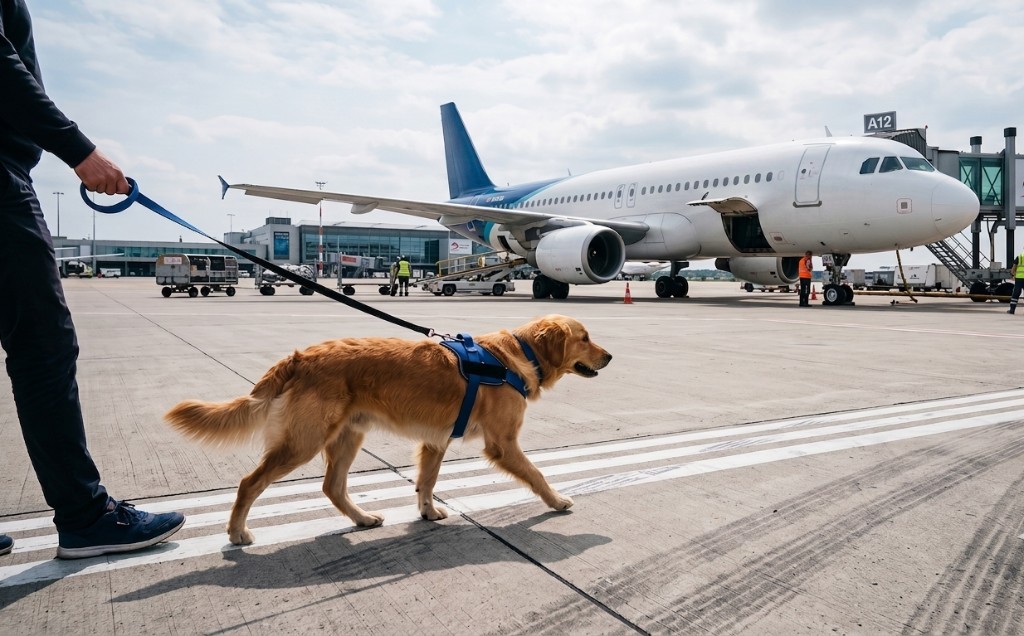
ESTCA is built mainly for dogs above today's usual cabin weight limits, where behaviour and welfare matter most. It sets the welfare baseline, the approval rules for trainers, and the five-area behavioural assessment a dog must meet before it travels in an aircraft cabin. Every certificate issued against the standard is published in a register that airlines, and anyone else, can check.
Public register look-up
Owner contact details are never returned. Public queries expose status, dates and the certifying trainer only.
Scope
Airlines are opening cabin carriage to larger dogs. Small under-seat pets are usually already covered by carrier size rules. ESTCA's main role is to make it possible for larger dogs to go in the cabin, strictly following the safety requirements and rules from the airlines, but with an assessed record showing they are fit to fly.
Existing documentation covers identity and health; carrier policy sets weight and dimensions. Neither addresses behaviour, so acceptance is often decided at check-in or the gate. ESTCA provides that assessment in advance, by an ESTCA-approved assessor against a published standard, in a public register carriers can verify at booking and check-in.
The result is that acceptance becomes a decision made with information rather than without it, supporting safety, animal welfare and operational efficiency. It does not replace existing documentation or carrier policy, and does not grant carriage.
What each document answers today
Weight & size
Carrier policy
Does the dog physically fit the cabin space sold?
Identity & health
EU Pet Passport · Animal Health Certificate
Is this the right animal, microchipped, vaccinated and cleared to cross the border?
Behaviour & welfare
ESTCA-STD-001
Is the dog actually fit to fly? Can the dog settle in a confined cabin space, accept handling by crew or unfamiliar people, and recover from a startle without distress?
An ESTCA certificate does not grant permission to fly. Full comparisonRegister look-upAccess ESTCA's certification platform here.
Journey
Tap or click to view full size
What each party gets
ESTCA
European Standard
Canine Travel Readiness Certification
Standard v1.2
The normative text
A carrier can read exactly what a certificate means before deciding whether to rely on it. No licence fee for the text; a small administrative fee covers assessor approval and registry operation.
Routes
Airlines & operators
Technical briefing, API review, and the boundary between a readiness signal and your own acceptance decision.
Airline pathway
Dog owners
Assessment, preparation and certification are delivered on the certification platform — a separate service from this register.
certified-estca.eu
Trainers
Eligibility, the train-the-trainer module, the code of conduct, and the accountability attached to every certificate issued.
certified-estca.eu
How it works
The whole point is that no one loses. The dog wins, because the welfare bar is set and observed. The owner wins, because they get real preparation rather than a guess at the gate. The trainer wins, because the work is recognised and accountable. The airline wins, because it can plan operations around a verifiable readiness signal it didn't have to invent.
01
Owner
Owners go to certified-estca.eu to find an ESTCA-approved assessor.
02
Trainer
The trainer assesses the dog across the five behavioural areas in the standard.
03
Registry
If the dog meets the standard, the certificate appears in the public register on estca.eu.
04
Airline
Airlines look up the certification via the API or the register. Cabin acceptance stays with the airline.
For airlines & operators
Look up certification status at booking, check-in or compliance via the public register or JSON API. Results do not replace airline approval, safety assessment or animal-health documentation.
Briefing
Request a briefing
How the standard and register sit next to check-in and cabin policy.
API
OpenAPI specification
Machine-readable verification contract for operator systems.
Pilot
Pilot programme interest
Early operational conversations. No partnership is claimed until both sides agree.
Status, dates, trainer and certification number. No owner contact data.
Public queries confirm readiness without exposing owners.
ESTCA does not set your weight policy or decide cabin acceptance.